CASE STUDY
Airblox OXP: Outcome Execution Protocol
Airblox OXP: Outcome Execution Protocol
GenAI
Blockchain
Composable UI
Conversational UI
Workflows
Air Freight
Supply chain
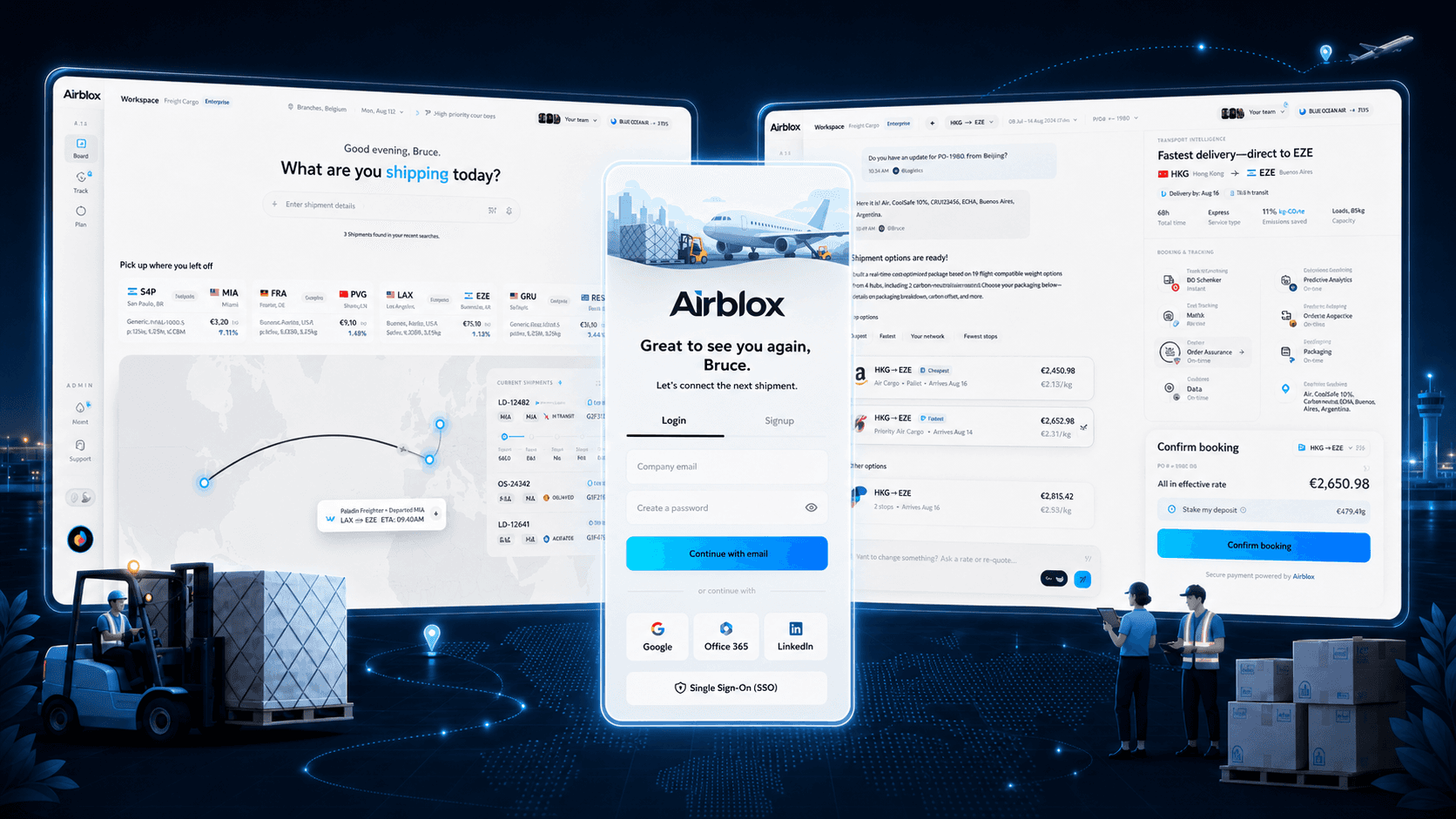
My team is building an AI-powered, blockchain solution that composes the supply chain with AI, and processes air freight bookings via the novel smart-contract protocol, OXP. Unlike traditional tokens and NFTs, OXP is an intelligent orchestration protocol that tokenizes outcomes, allowing it to: a) track shipments through completion, b) enforce trustless transparency, and c) pay vendors automatically via escrow release upon the completion of service-milestones.
My team is building an AI-powered, blockchain solution that composes the supply chain with AI, and processes air freight bookings via the novel smart-contract protocol, OXP.
Unlike traditional tokens and NFTs, OXP is an intelligent orchestration protocol that tokenizes outcomes, allowing it to: a) track shipments through completion, b) enforce trustless transparency, and c) pay vendors automatically via escrow release upon the completion of service-milestones.
ROLE
Founding Head of Design
Inventor of OXP
TIMELINE
10 months
Aug. 2025–Present
SCOPE
Inventor, Prototype, Interaction Design
TEAM
4 engineers, 1 designer, 1 BD leader, 1 data scientist
ROLE
Founding Head of Design
Inventor of OXP
TIMELINE
10 months
Aug. 2025–Present
SCOPE
Inventor, Prototype, Interaction Design
TEAM
4 engineers, 1 designer, 1 BD leader, 1 data scientist
THE PROBLEM
Solving for opacity in supply chain, where shippers pay 18–40% over cost on every shipment.
Solving for opacity in supply chain, where shippers pay 18–40% over cost on every shipment.
How supply chain works currently:
How supply chain works currently:

Government regulations require Shippers to work with Freight Forwarders—intermediary orchestrators of the supply chain.
Government regulations require Shippers to work with Freight Forwarders—intermediary orchestrators of the supply chain.
This mandate artificially inverts traditional supply–demand marketplace dynamics in favor of supply.
This mandate artificially inverts traditional supply–demand marketplace dynamics in favor of supply.

Forwarders optimize for convenience and margin, often adding intermediary vendor costs (2–4%), retaining volume savings (1–21%), and charging standard forwarding fees (15–20%) rather than passing full savings through to shippers.
Forwarders optimize for convenience and margin, often adding intermediary vendor costs (2–4%), retaining volume savings (1–21%), and charging standard forwarding fees (15–20%) rather than passing full savings through to shippers.

With so many vendors communicating, the current system is weighed down by structural data fragmentation, leading to excessive disputes where there is no source of truth.
With so many vendors communicating, the current system is weighed down by structural data fragmentation, leading to excessive disputes where there is no source of truth.
UP FIRST
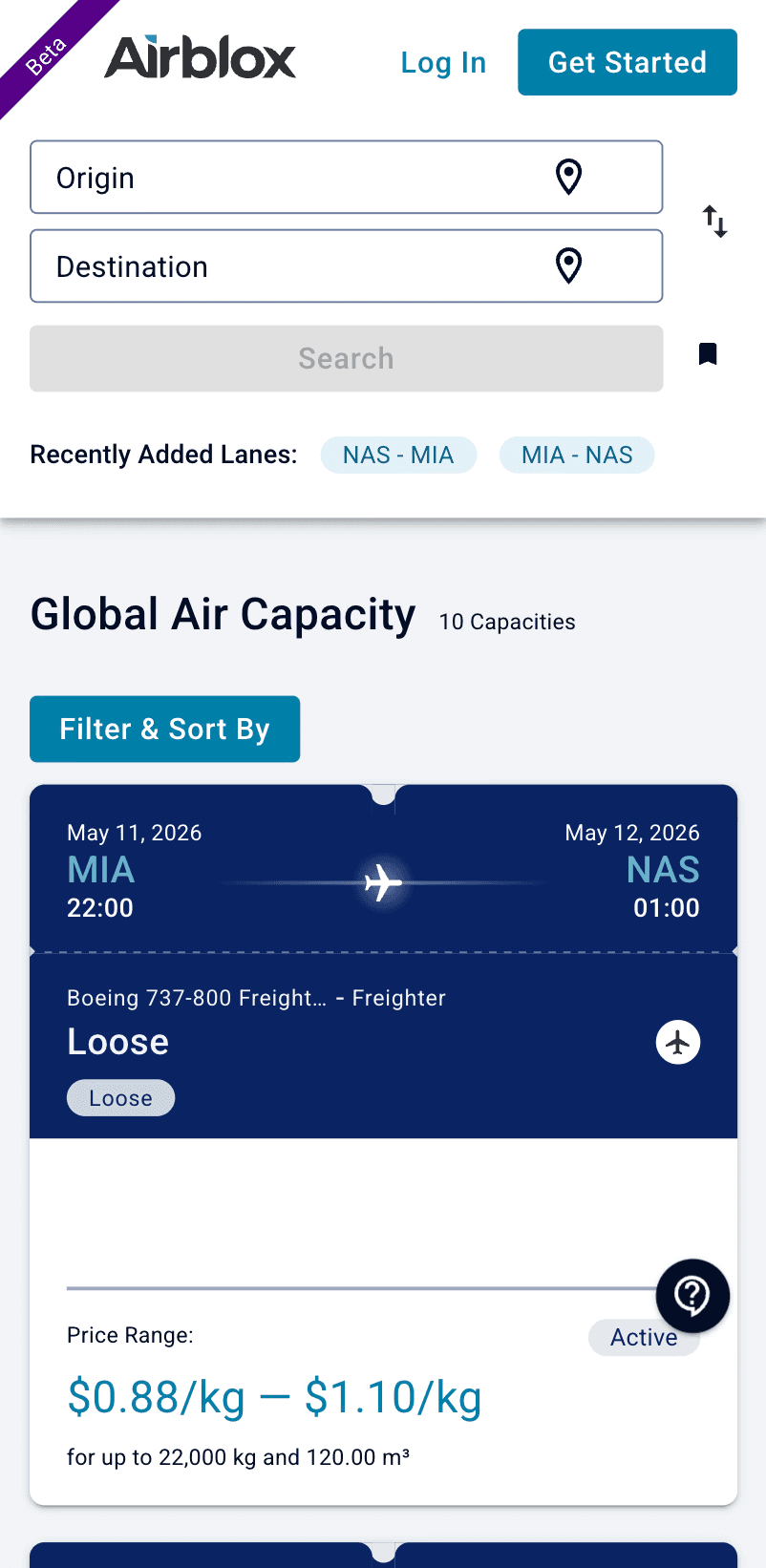
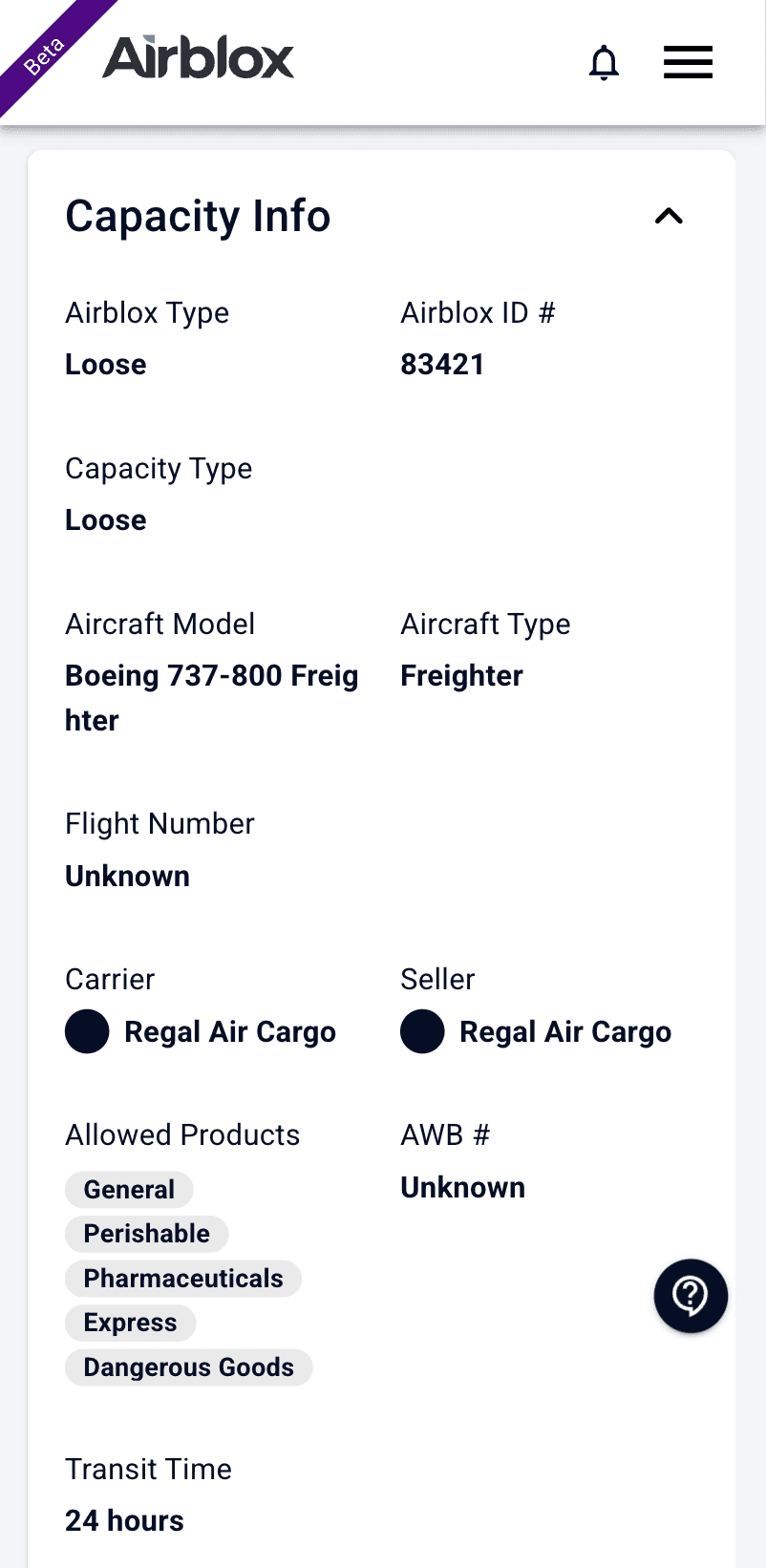
An audit of the original marketplace UI revealed a systemic mismatch against core user research insights
An audit of the original marketplace UI revealed a systemic mismatch against core user research insights
The first product cost $7M+ to build and flopped when it launched. I was hired in 2024 to find out why.
The first product cost $7M+ to build and flopped when it launched. I was hired in 2024 to find out why.
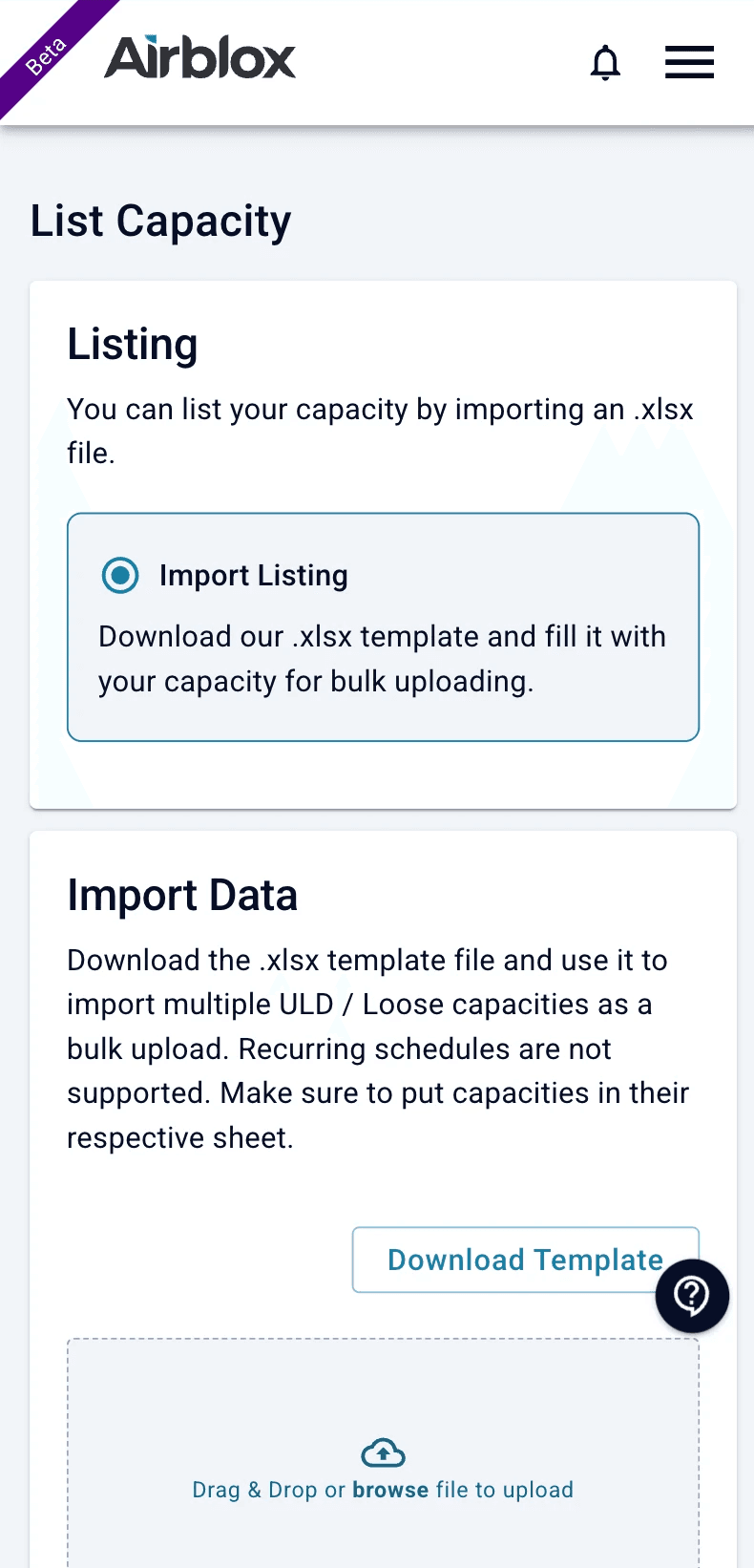
Key UX heuristic broken
Key UX heuristic broken
The original product failed due to a mismatch between the system and the real world (#2), as it did not capture the way industry players searched and communicated—instead it tried to force users to change their decades-old habits.
The original product failed due to a mismatch between the system and the real world (#2), as it did not capture the way industry players searched and communicated—instead it tried to force users to change their decades-old habits.
UX Themes & UXR insights:
UX Themes & UXR insights:
Legacy communication: Market participants still conduct business through legacy communication methods, i.e., phone, email, and spreadsheets—the original product tried to force digitization without respecting these change management constraints.
Legacy communication: Market participants still conduct business through legacy communication methods, i.e., phone, email, and spreadsheets—the original product tried to force digitization without respecting these change management constraints.
Emulating natural language: By 2024, the air freight vertical had resisted digitalization—no product could emulate the ease of booking shipments over email with natural language.
Emulating natural language: By 2024, the air freight vertical had resisted digitalization—no product could emulate the ease of booking shipments over email with natural language.
Rich searches: The original platform just fielded origin and destination airports. But real searches were rich, including commodity type, dimensions, and more.
Rich searches: The original platform just fielded origin and destination airports. But real searches were rich, including commodity type, dimensions, and more.
Full-service: Shippers need the entire supply chain to be constructed, including the airline and 10–20 other service providers in the chain.
Full-service: Shippers need the entire supply chain to be constructed, including the airline and 10–20 other service providers in the chain.
Product-market fit issues: The first product mistakingly sought to add value to the supply side (carriers), and therefore failed to drive demand.
Product-market fit issues: The first product mistakingly sought to add value to the supply side (carriers), and therefore failed to drive demand.
UI PREVIEW
By using AI to compose freight workflows and blockchain logic to orchestrate execution, Airblox eliminates excess margins and opacity—reducing shipper costs by 18–40%.
By using AI to compose freight workflows and blockchain logic to orchestrate execution, Airblox eliminates excess margins and opacity—reducing shipper costs by 18–40%.
The system removes excess costs in three ways: 15% through automated forwarder coordination, 2–4% by eliminating information-arbitrage middlemen, and 1–21% through crowdsourced volume consolidation. To enforce transparency, vendors are incentivized with instant sales as their services are invoked through the ledger, creating a built-in network effect where transparency becomes the cost of doing business.
The system removes excess costs in three ways: 15% through automated forwarder coordination, 2–4% by eliminating information-arbitrage middlemen, and 1–21% through crowdsourced volume consolidation. To enforce transparency, vendors are incentivized with instant sales as their services are invoked through the ledger, creating a built-in network effect where transparency becomes the cost of doing business.

Minimalist dashboard provides high-level visibility into current active shipments, and drives users into the booking flow. A sonner is used to notify users of ingested shipment requests the system has pulled from their emails or texts.
Minimalist dashboard provides high-level visibility into current active shipments, and drives users into the booking flow. A sonner is used to notify users of ingested shipment requests the system has pulled from their emails or texts.

An AI-powered conversation UI guides booking requests to 100% completion. Then our GenAI and ranking algorithm compose the service chain and suggests packages. In a single click, the OXP smart-contract protocol is executed and the transation is minted into the blockchain ledger.
An AI-powered conversation UI guides booking requests to 100% completion. Then our GenAI and ranking algorithm compose the service chain and suggests packages. In a single click, the OXP smart-contract protocol is executed and the transation is minted into the blockchain ledger.
THE SOLUTION
The goal of Airblox OXP is to automate the orchestration of the supply that Forwarders handle. This eliminates the excess costs to shippers creating a built-in network effect, and the blockchain ledger provides an immutable record for resolving disputes. On the ground, we're building a global network of providers that can be dynamically assembled with AI at the time of booking.
With OXP the service chain is: composed by AI, orchestrated by the OXP smart contract rules, and tracked by an IoT device that transmits milestone data to the OXP ledger. In sum, OXP is a check-mate play to the status quo, as it inverts the market dynamics back in favor of shippers.
The goal of Airblox OXP is to automate the orchestration of the supply that Forwarders handle. This eliminates the excess costs to shippers creating a built-in network effect, and the blockchain ledger provides an immutable record for resolving disputes. On the ground, we're building a global network of providers that can be dynamically assembled with AI at the time of booking.
With OXP the service chain is: composed by AI, orchestrated by the OXP smart contract rules, and tracked by an IoT device that transmits milestone data to the OXP ledger. In sum, OXP is a check-mate play to the status quo, as it inverts the market dynamics back in favor of shippers.
HOW IT WORKS
OXP fuses GenAI, blockchain, and IoT to automate the supply chain with AI and smart-contract logic.
OXP fuses GenAI, blockchain, and IoT to automate the supply chain with AI and smart-contract logic.
Ingesting NL sources
Ingesting NL sources
To begin, Airblox ingests booking requests from any source (email, XLXS or PDF attachments, text, NL prompt) → AI maps the request to a semantic shipment schema → finally, our AI agent identifies missing fields based on shipment context and asks follow up questions to guide the user to a complete booking request.
To begin, Airblox ingests booking requests from any source (email, XLXS or PDF attachments, text, NL prompt) → AI maps the request to a semantic shipment schema → finally, our AI agent identifies missing fields based on shipment context and asks follow up questions to guide the user to a complete booking request.
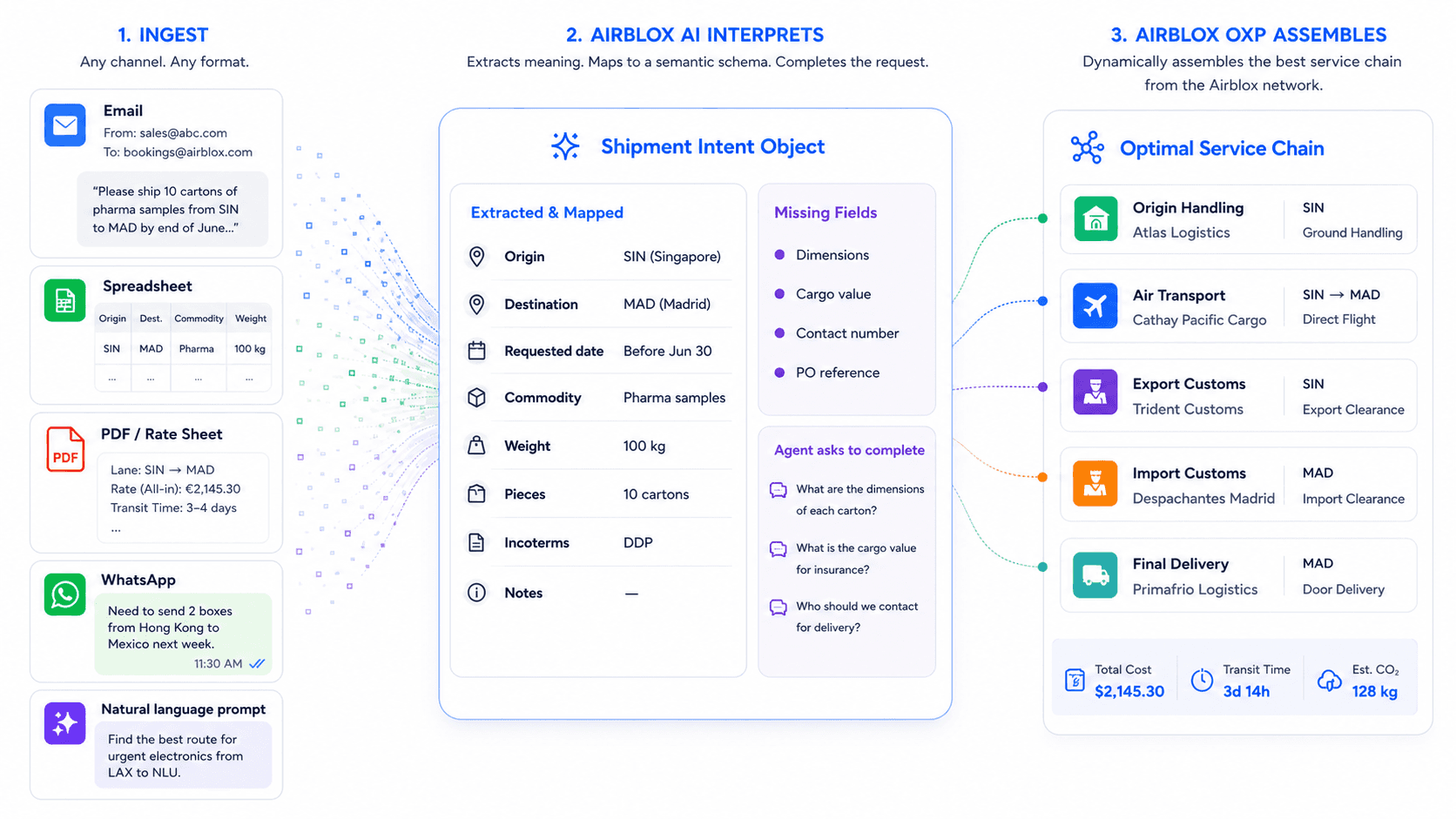
Artifact generated with GenAI for illustration purposes.
Composing service chain with AI
Once the shipment request is complete, Airblox composes the optimal service chain with GenAI and suggests top packages, i.e. fastest, cheapest, optimal, fuel efficient. First, the ranking algorithm assesses available providers against their service coverage and shipment constraints. The AI layer then synthesizes those ranked options into clear package recommendations the user can compare and confirm.
Once the shipment request is complete, Airblox composes the optimal service chain with GenAI and suggests top packages, i.e. fastest, cheapest, optimal, fuel efficient. First, the ranking algorithm assesses available providers against their service coverage and shipment constraints. The AI layer then synthesizes those ranked options into clear package recommendations the user can compare and confirm.

Novel blockchain architecture
Until now, most crypto tokenization has been framed around two dominant primitives: fungible value through ERC-20 and unique ownership through ERC-721. OXP introduces a third primitive: executable service outcomes. Unlike traditional crypto which tokenizes ownership, OXP is an entirely novel smart contract protocol that tokenizes outcomes, orchestrates the service chain for a shipment, and provides a trustless ledger for operational record keeping to manage disputes.
Until now, most crypto tokenization has been framed around two dominant primitives: fungible value through ERC-20 and unique ownership through ERC-721. OXP introduces a third primitive: executable service outcomes. Unlike traditional crypto which tokenizes ownership, OXP is an entirely novel smart contract protocol that tokenizes outcomes, orchestrates the service chain for a shipment, and provides a trustless ledger for operational record keeping to manage disputes.
ERC-20: Fungible Tokens
Best understood as cryptocurrency-style units.
ERC-20 says "You own x-many units of this fungible token."
ERC-20: Fungible Tokens
Best understood as cryptocurrency-style units.
ERC-20 says "You own x-many units of this fungible token."
OXP-1: Outcome Execution Protocol
Unlike ERC-20 and ERC-721, OXP tokenizes the completion of service outcomes.
OXP says: “Verified milestones release payment for this service outcome.”
OXP-1: Outcome Execution Protocol
Unlike ERC-20 and ERC-721, OXP tokenizes the completion of service outcomes.
OXP says: “Verified milestones release payment for this service outcome.”
ERC-721: Non-fungible tokens (NFTs)
Defines unique digital assets and ownership records.
ERC-721 says: “You own this unique thing.”
ERC-721: Non-fungible tokens (NFTs)
Defines unique digital assets and ownership records.
ERC-721 says: “You own this unique thing.”
IoT Device
IoT tracking device transmits real-time tracking data into the OXP ledger—funds are held in a yield-bearing escrow account and payment is released to service providers upon successful milestone completion.
IoT tracking device transmits real-time tracking data into the OXP ledger—funds are held in a yield-bearing escrow account and payment is released to service providers upon successful milestone completion.
UX ARCHITECTURE
User flow
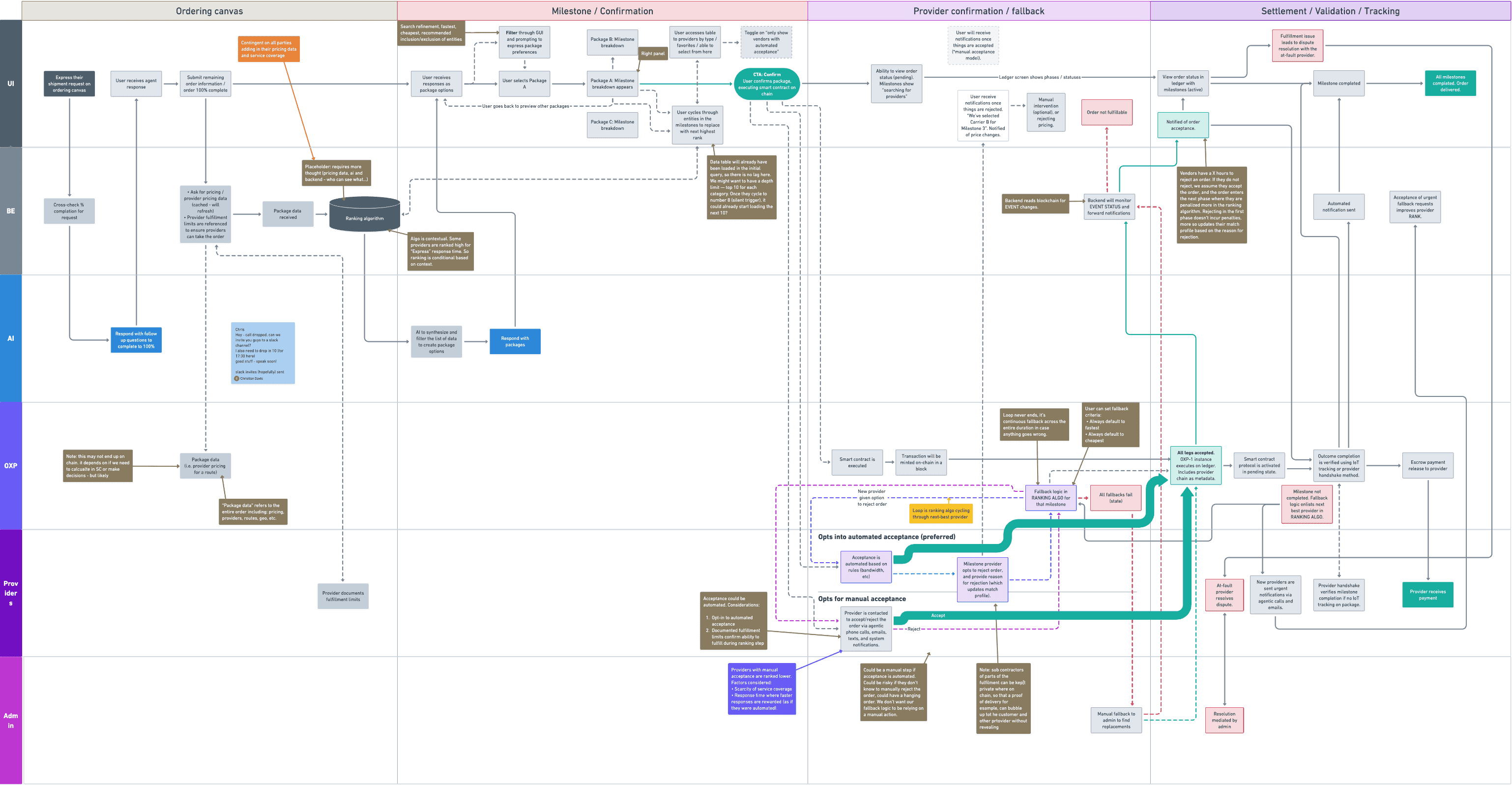
Service blueprint
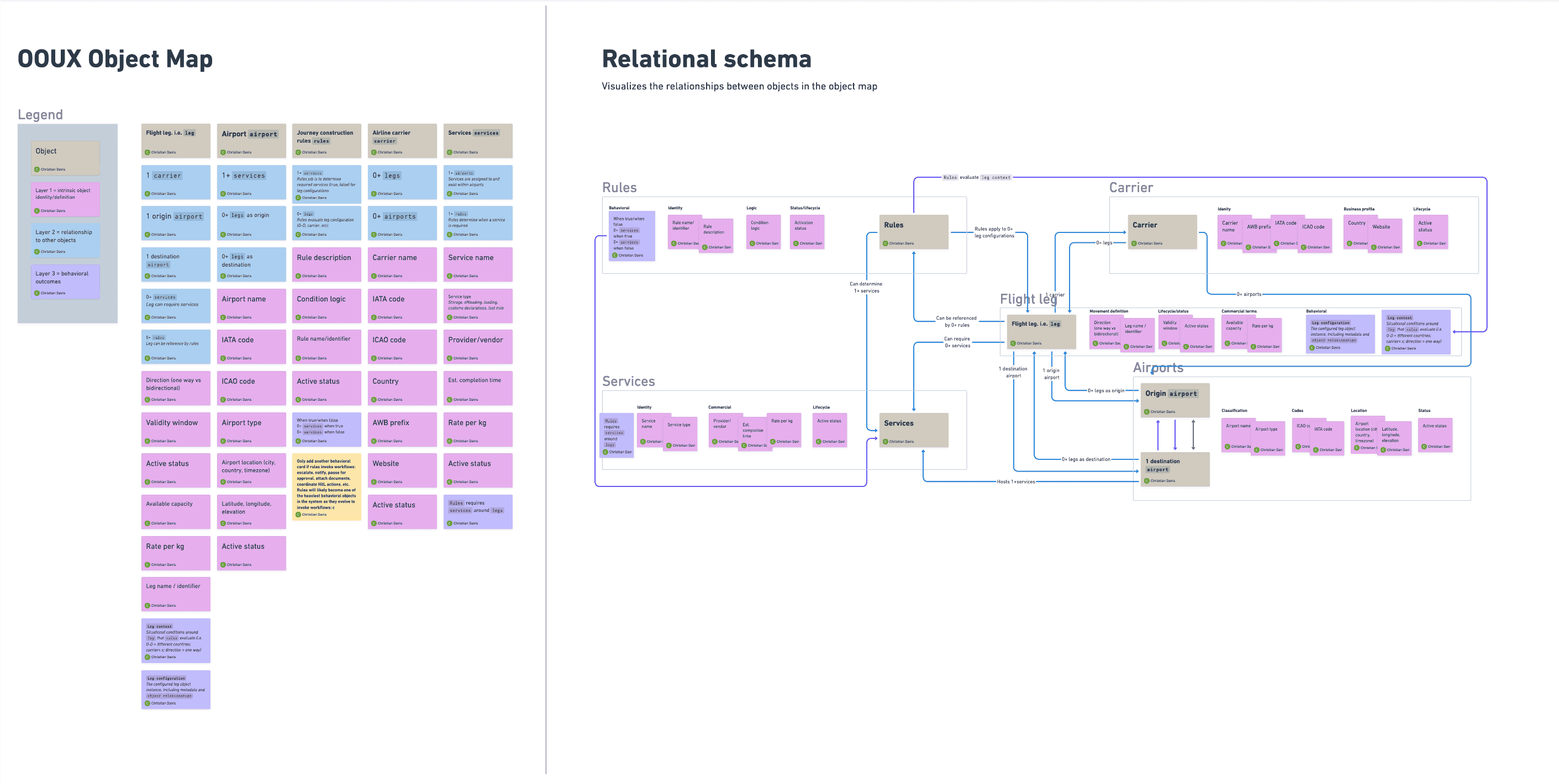
OOUX object map
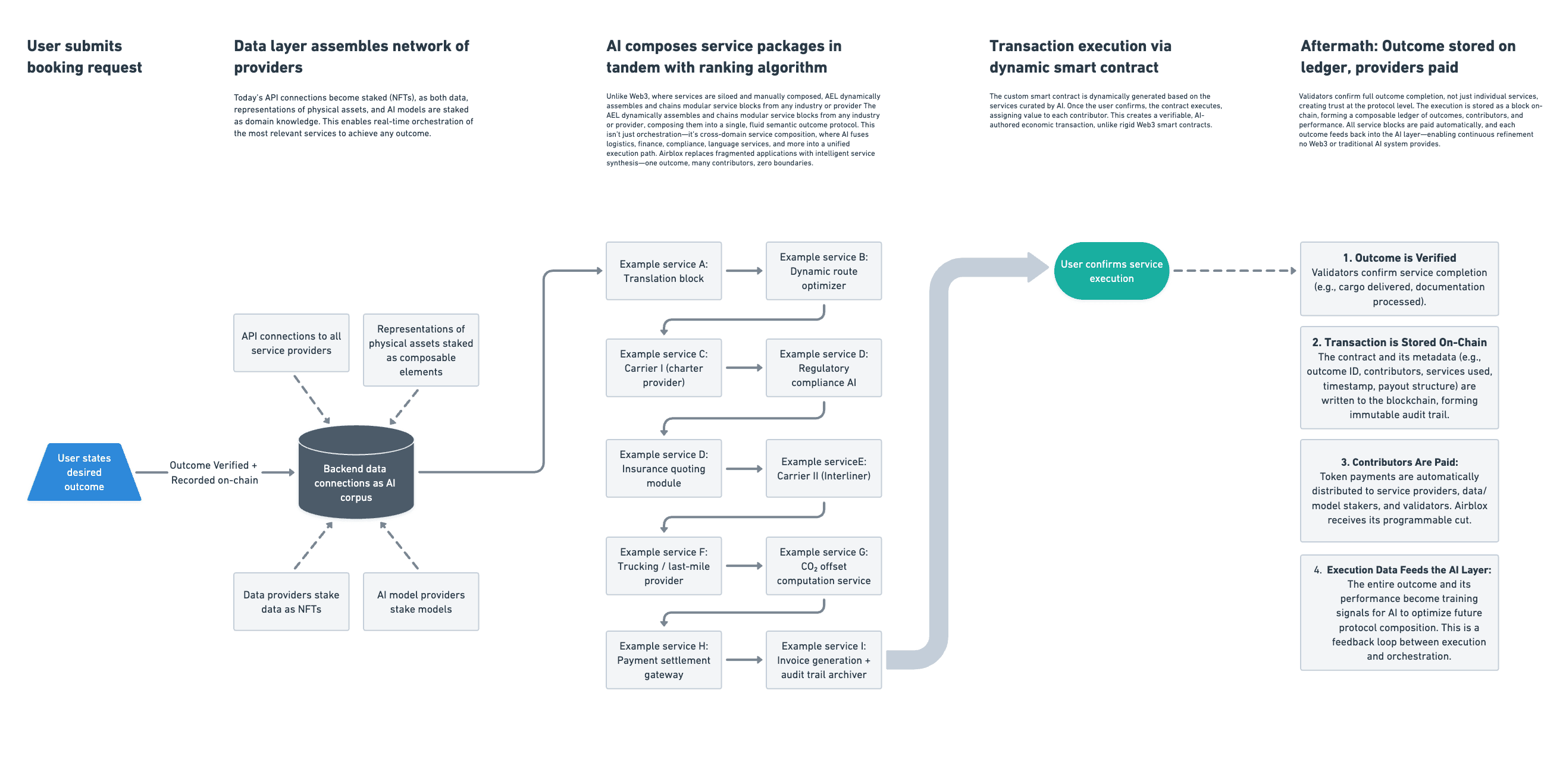
The user flow illustrates the end-to-end OXP model
The flow begins with the user’s search intent, which is filtered through the data model, then routed through a composable vendor layer (A–I) to escrow release on milestone completion.
UX ARCHITECTURE
User flow
Service blueprint
OOUX object map
The user flow illustrates the end-to-end OXP model
The flow begins with the user’s search intent, which is filtered through the data model, then routed through a composable vendor layer (A–I) to escrow release on milestone completion.
FINAL DESIGN
To bring it all to life, I was tasked with designing the core booking and tracking experience for shippers. I prototyped a conversational booking flow powered by an AI agent that interprets natural-language shipment requests, asks for missing details, and guides users to a completed booking. I also added in-app team and shipment-party communication, along with request ingestion from external sources, to reduce change-management friction around legacy communication methods.
To bring it all to life, I was tasked with designing the core booking and tracking experience for shippers. I prototyped a conversational booking flow powered by an AI agent that interprets natural-language shipment requests, asks for missing details, and guides users to a completed booking. I also added in-app team and shipment-party communication, along with request ingestion from external sources, to reduce change-management friction around legacy communication methods.
Onboarding
Because the original product struggled with retention, we placed heavy emphasis on the starter experience as a trust-rebuilding moment. The LLM-guided onboarding flow was designed to overcome negative brand perception quickly, helping new users understand Airblox’s value by making the flow itself the “aha” moment.
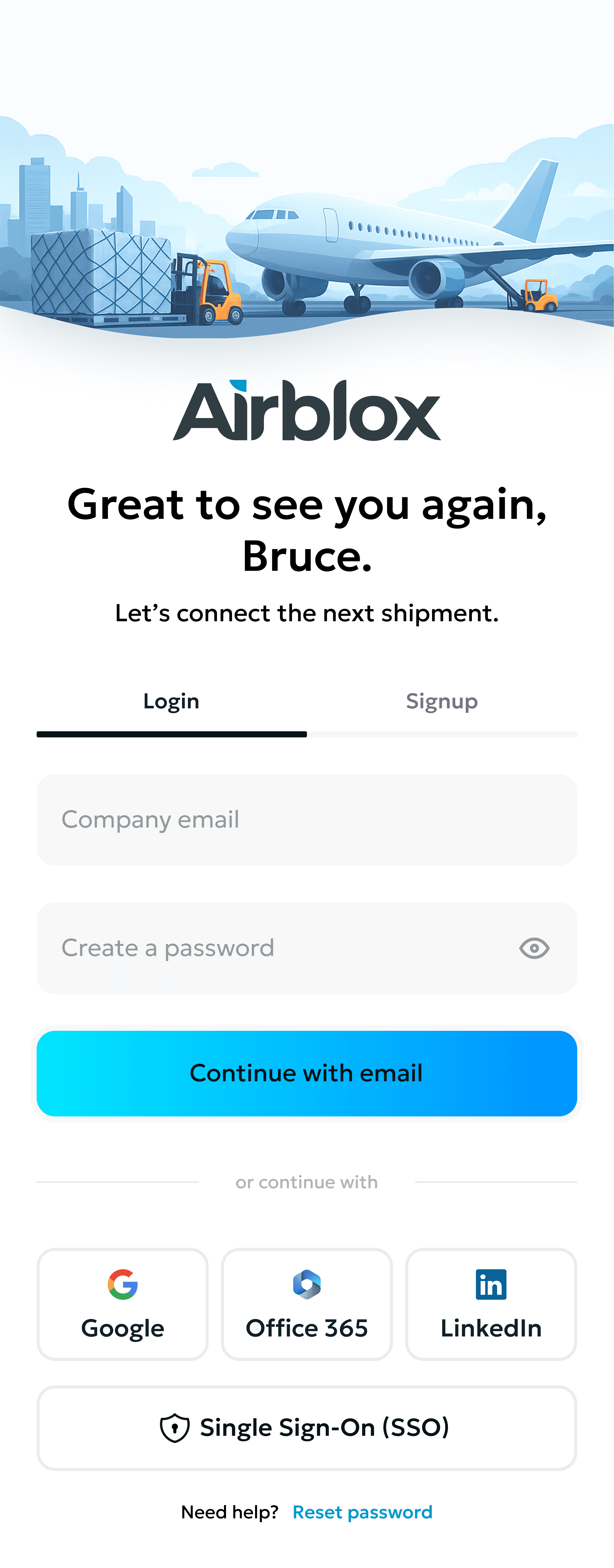

Amplitude events were added across the onboarding flow to track conversion rates, drop-off points, and moments of friction as users moved through the starter experience.
Onboarding
Because the original product struggled with retention, we placed heavy emphasis on the starter experience as a trust-rebuilding moment. The LLM-guided onboarding flow was designed to overcome negative brand perception quickly, helping new users understand Airblox’s value by making the flow itself the “aha” moment.
Amplitude events were added across the onboarding flow to track conversion rates, drop-off points, and moments of friction as users moved through the starter experience.
Dashboard
A personalized dashboard provides high-level visibility into current active shipments, and drives users into the booking flow. Newly ingested requests appear below in a sonner.
On the booking dashboard, a sonner molecule is used to itemize incoming requests.
Dashboard
A personalized dashboard provides high-level visibility into current active shipments, and drives users into the booking flow. Newly ingested requests appear below in a sonner.
On the booking dashboard, a sonner molecule is used to itemize incoming requests.
Request inbox
Airblox's RFQ inbox aggregates communications from emails, text messages, WhatsApp, and WeChat into booking threads—turning scattered email threads, spreadsheets, and texts, into a dedicated CRM-lite workspace where quotes, documents, bids, and conversations stay attached to the booking request. The inbox allows all players to conduct business as usual, while agreed-upon contract rates for specific lanes are captured in the OXP backend and reused for future booking logic.

The inbox aggregates incoming bids from carriers and facilitates in-app communication via phone and direct messaging. Instead of forcing carriers to adopt our system, they are able to respond directly to the Shipper's emails.
Request inbox
Airblox's RFQ inbox aggregates communications from emails, text messages, WhatsApp, and WeChat into booking threads—turning scattered email threads, spreadsheets, and texts, into a dedicated CRM-lite workspace where quotes, documents, bids, and conversations stay attached to the booking request. The inbox allows all players to conduct business as usual, while agreed-upon contract rates for specific lanes are captured in the OXP backend and reused for future booking logic.
The inbox aggregates incoming bids from carriers and facilitates in-app communication via phone and direct messaging. Instead of forcing carriers to adopt our system, they are able to respond directly to the Shipper's emails.
Communication
To support rich searches, I used a conversational UI that let's users express booking request in natural language as they are accustomed. Airblox AI maps the request to a semantic schema and guides it to completion, while AI mode can be toggled off to bring team members into the same shipment thread.

Right panel reflects search progress and itemizes key details and request status. The LLM employs common GUI elements such as selectors to improve interaction costs. Note that spreadsheets are automatically ingested via email when entering from the inbox or sonner.
Communication
To support rich searches, I used a conversational UI that let's users express booking request in natural language as they are accustomed. Airblox AI maps the request to a semantic schema and guides it to completion, while AI mode can be toggled off to bring team members into the same shipment thread.
Right panel reflects search progress and itemizes key details and request status. The LLM employs common GUI elements such as selectors to improve interaction costs. Note that spreadsheets are automatically ingested via email when entering from the inbox or sonner.
AI Composition
Once the booking request is ready, Airblox AI works with the OXP ranking algorithm to compose the optimal service chain and suggest bookable packages. With one click, the selected package executes the OXP smart-contract protocol and mints the transaction to the blockchain ledger.
Notable highlights: 1) Two-click interaction cost to confirm the booking. 2) Confirm Booking CTA executes the smart contract OXP-1. 3) Preferred payment method is saved on file. Individual vendor nodes can be edited by clicking on the service chain component.
AI Composition
Once the booking request is ready, Airblox AI works with the OXP ranking algorithm to compose the optimal service chain and suggest bookable packages. With one click, the selected package executes the OXP smart-contract protocol and mints the transaction to the blockchain ledger.
Notable highlights: 1) Two-click interaction cost to confirm the booking. 2) Confirm Booking CTA executes the smart contract OXP-1. 3) Preferred payment method is saved on file. Individual vendor nodes can be edited by clicking on the service chain component.
Tracking
The final screen in the core booking workflow allows shippers to track a shipment through completion. Each vendor is itemized within the service pipeline, showing current milestone status, and whether payment has been released, pending, or held. The map provides shipment location, and the right panel shows active, pending, and completed shipments in the OXP ledger. The Track UI offers a complete operational record of shipments.
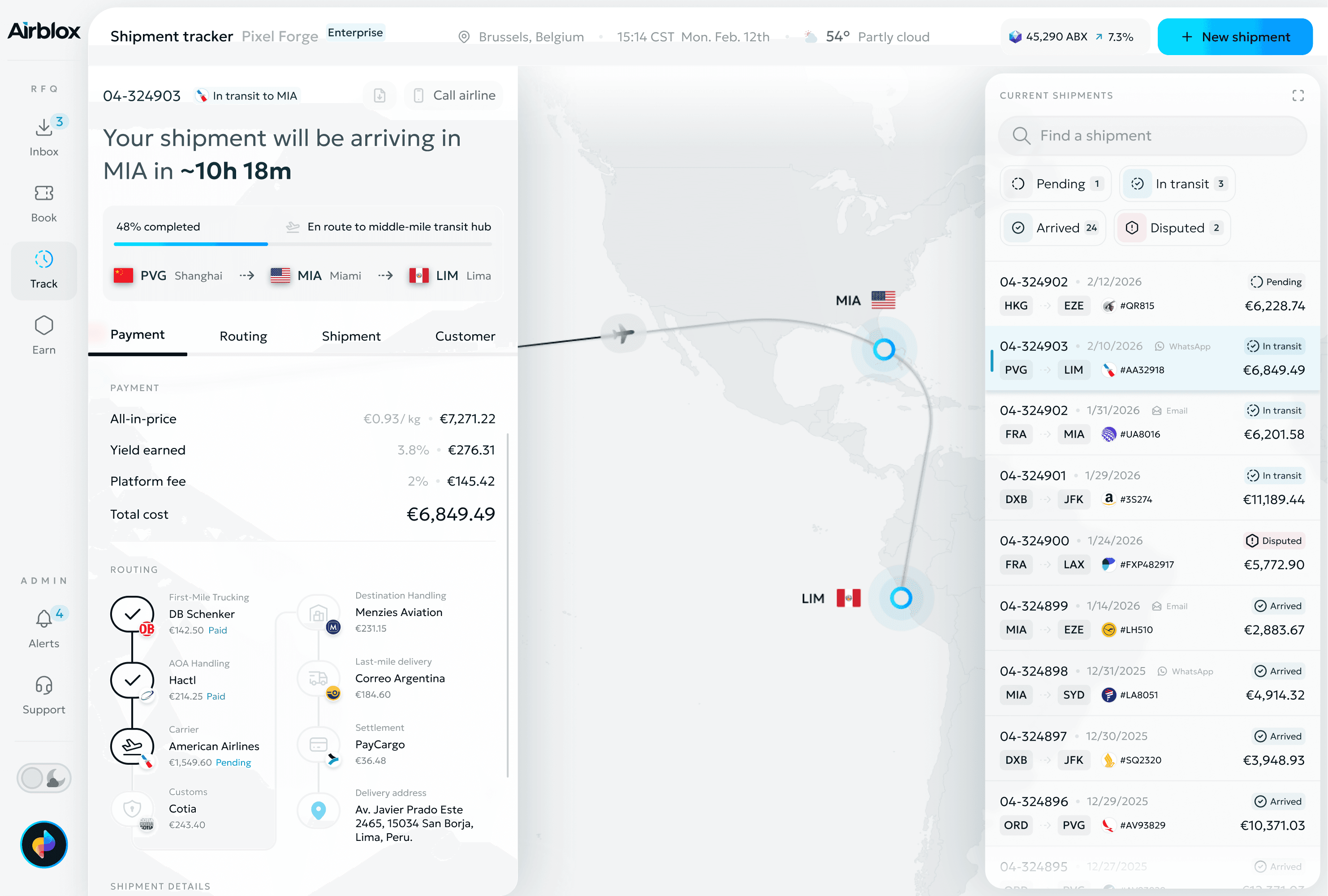
The operational record becomes a jumping-off point for managing exceptions and resolving disputes.
Tracking
The final screen in the core booking workflow allows shippers to track a shipment through completion. Each vendor is itemized within the service pipeline, showing current milestone status, and whether payment has been released, pending, or held. The map provides shipment location, and the right panel shows active, pending, and completed shipments in the OXP ledger. The Track UI offers a complete operational record of shipments.
The operational record becomes a jumping-off point for managing exceptions and resolving disputes.
RESULTS
Since I began with Airblox, the company grew rapidly through the MVP, reaching $23M ARR in 2025 and projecting $43M in 2026. The ongoing OXP build expanded that momentum into strategic partnerships with China’s largest eCommerce players and a $4M Series-A raise.
Since I began with Airblox, the company grew rapidly through the MVP, reaching $23M ARR in 2025 and projecting $43M in 2026. The ongoing OXP build expanded that momentum into strategic partnerships with China’s largest eCommerce players and a $4M Series-A raise.
$
M+
Raised in Series-A funding
$
M+
Raised in Series-A funding
$
M+
ARR reached in 2025
$
M+
ARR reached in 2025
Strategic MOUs signed
Strategic MOUs signed
s
Investor pitches supported
s
Investor pitches supported
OUR PARTNERS
MOUs and partner conversations supported by the product vision
MOUs and partner conversations supported by the product vision